Unethical Practices
Background
I performed at the Barnwood Bravo Theater at Kellie's Homestead Restaurant for three years. The agreement was that I got a percentage of the ticket sales. They were always slow to pass on my share, but they did eventually until September of 2022. From then until I left at the end of August of 2023 they kept every penny of my share for themselves. The amount of my money that they admitted to keeping was $14,749.50. Performing is my full time job, so that was the money I needed to keep my business afloat, eat, pay my home mortgage and so forth. Since I left, they have made some small payments, but not enough to even cover the fourth quarter of 2022. I still have not received any of my share of the money I brought in during 2023.
Documentation from Final Year There
They were always bad about paying me my share of the ticket sales in a timely manner. They regularly made commitments to fix things, but almost always failed to keep them--including once within a matter of hours. In that case, after multiple weeks of telling me they'd pay me the next week and not doing it, the owner told me she was going to go write the check, and that I should see her before I left. When I went to find her, she'd left without writing a check. I was told she'd either have the check next week, or call me to make other arrangements. She did neither. (I was eventually paid for this time period.)
During the time I was there, I was given many excuses for the late payments. They were short on money because they were too nice to fire employees over the holiday season, but now that the holidays are over... They're waiting on a tax rebate, and as soon as that comes in... They have a big loan they're paying off, but as soon as that's taken care of...
Here is a bit of documentation from my final 11 months there.
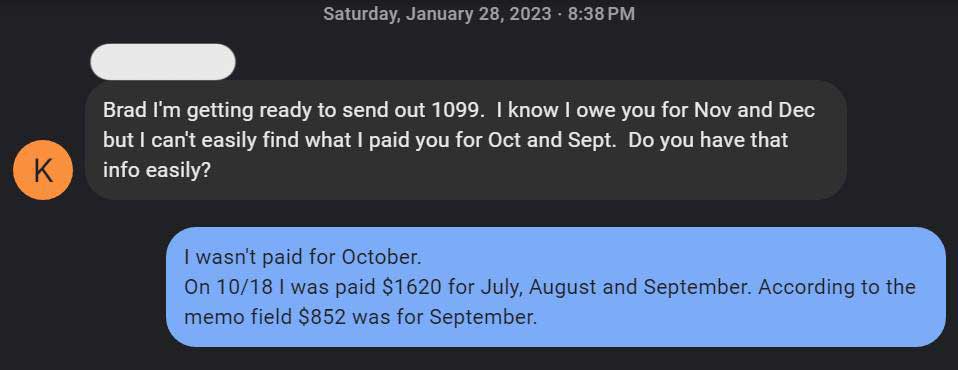
First are some text messages from January - March 2023, indicating that I hadn't been paid for anything after September of 2022.

Next is a text from July when I told them I'd be leaving at the end of August 2023 unless something changed. The text mentions Venmo. I don't have it in writing, but was told that she'd send Venmo payments every other week when she did payroll until I was caught up. Six weeks later, no payments had been made, and I left.
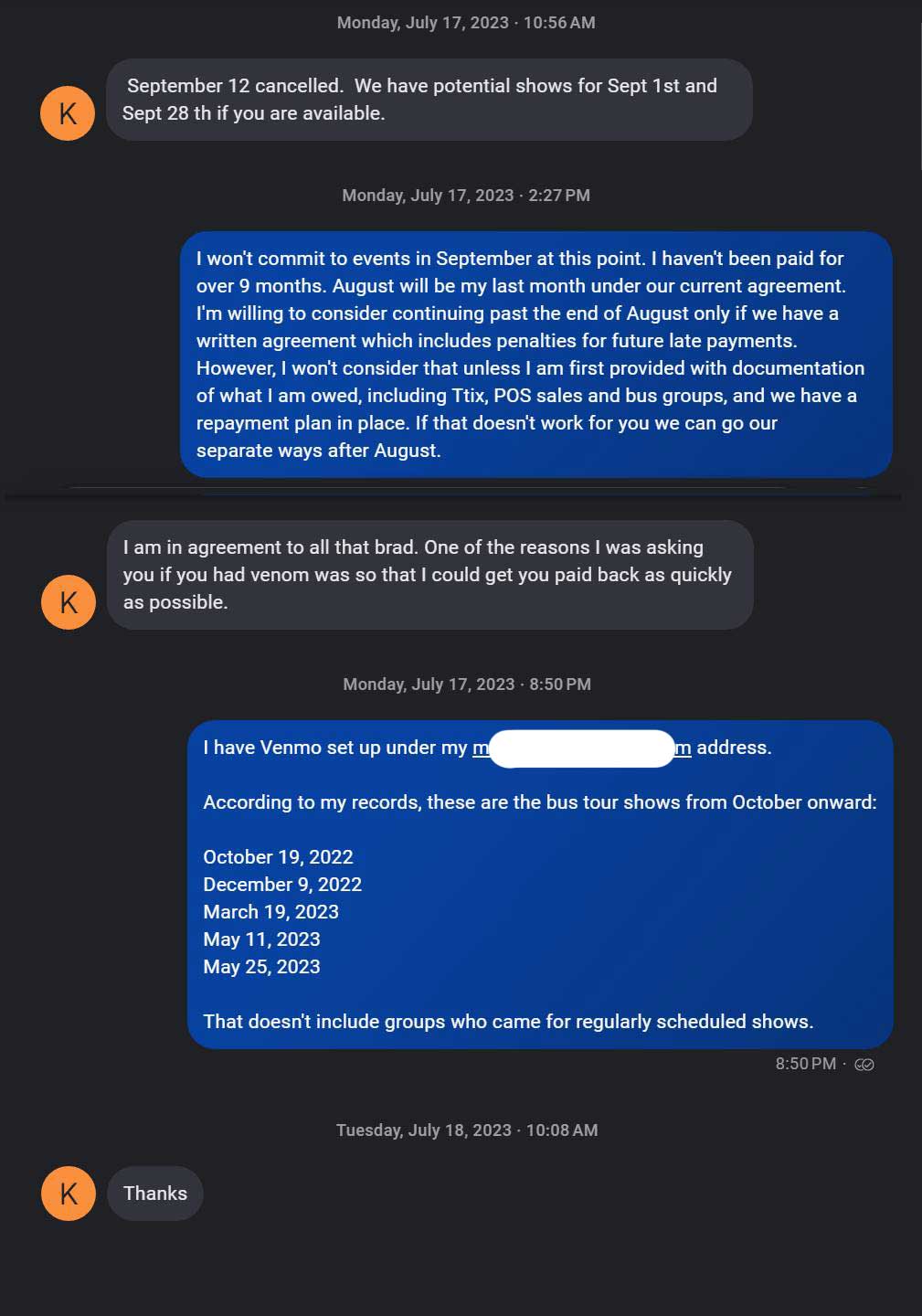
I will add that the owner has accused me of behaving in an unchristlike manner by not talking to her directly about this issue. These texts should illustrate that I did talk about the issue for a time. However, once someone demonstrates that they are consistently unwilling to honor their word, I see no obligation, Christian or otherwise, to continue the conversation. In fact, I'd argue it would be pointless to do so.
After I Left
When I left in August 2023, I agreed to do the bus tour groups that were already booked for dates after my departure. I did this because tour group leaders hate it if you cause them to not be able to deliver what they promised to their group. I didn't want my name associated with that.
I received a request to do a show that would have conflicted with those performances at Kellie's. As you can imagine, I needed the money at that point, and that event would likely have paid around $1,500. However, I had given my word, and that means something. So I turned the inquiry away, even though it was likely I wouldn't get paid for the tour group performances at Kellie's.
Three weeks before the scheduled performance, the owner texted me and said, "We won't be needing you." I don't know, but I suspect they hired someone else to perform and gave the tour group the impression that the change was my fault. I was tempted to hang out in the parking lot to see if a group showed up, and, if they did, explain the situation. But I decided against it.
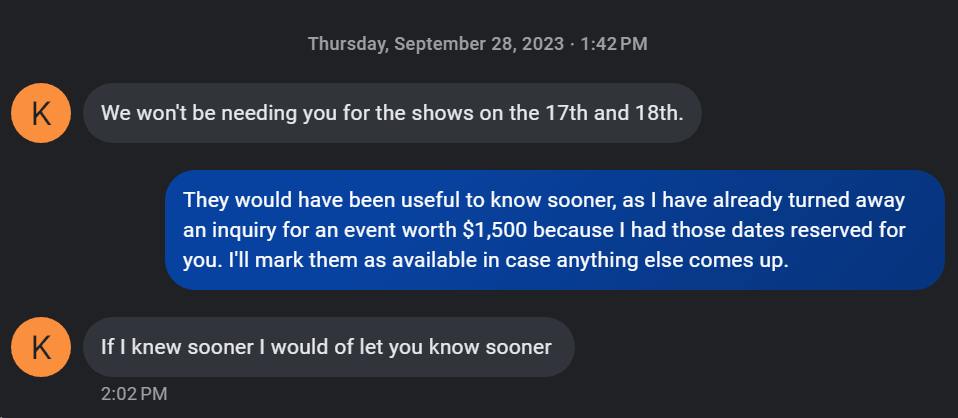
This isn't a situation where I have any legal claim against them for the money I lost. Normally, my performance contracts have a clause to deal with last minute cancellations. This wasn't the case here, because I thought their business and mine were equally sharing the risk of a group cancelling on us. When I began my business relationship with Kellie's I didn't consider that I needed to have protection from them. If you're considering a business relationship with them, learn from my mistake.
The Months Following my Departure
I started sending them invoices for the amount they said they owed me. They completely ignored the invoices--no payments or contact of any kind. This went on through September, October, November, December, January, February, March and April. In May, my sister reached out to the owner. I didn't ask her to, she just knew the harm this company had caused me and wanted to do something. She suggested word was getting out about their business practices, and it would be better for their business to make things right.
Well, the owner finally sent a small payment of $250. This was followed by an incredibly sanctimonious email explaining how I was failing to live up to their moral standards. It also included what I interpreted as a threat to not pay me if I continued to "bad mouth" them.
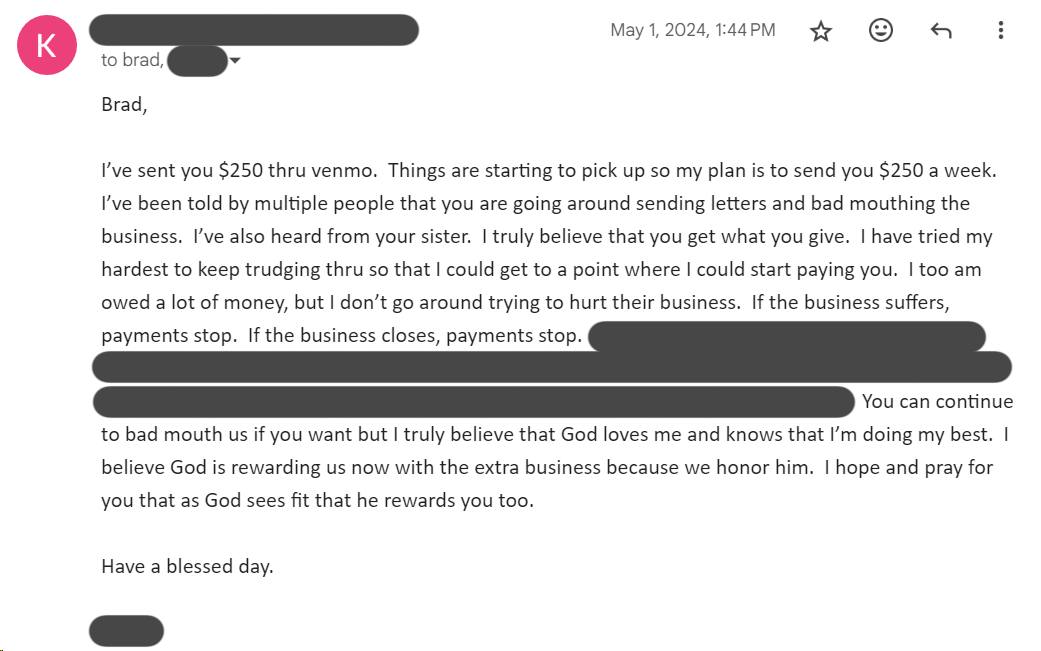
Here's the funniest part. Literally the day before she sent this screed about the evils of publicly talking about a business that mistreats you, she "named and shamed" Cincinnati Bell on FB for poor customer service. More recently she left a scathing public review of a church that she says didn't show up for their group reservation.
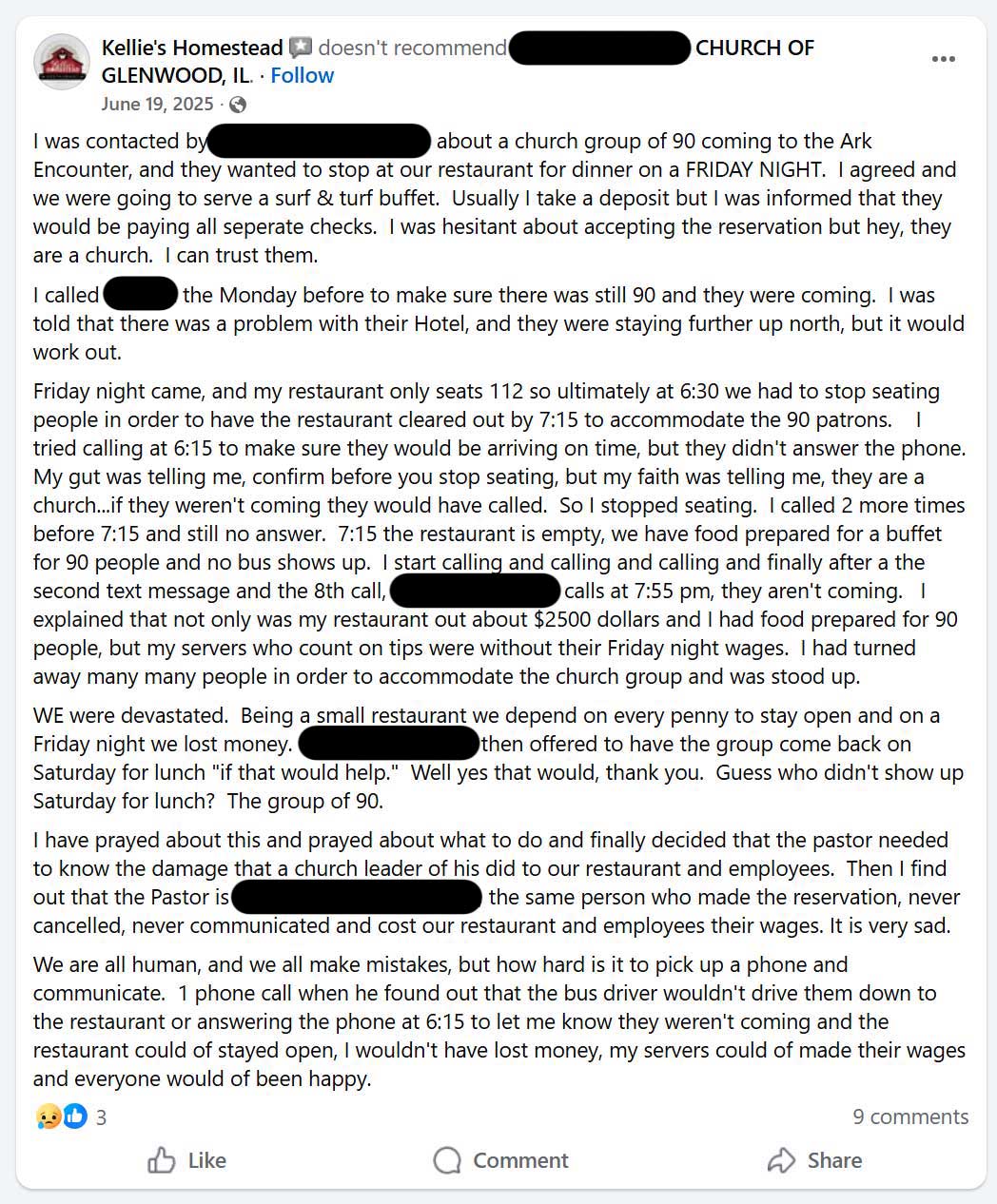
So, apparently it's fine for her to complain about other businesses, but it's the height of immorality for someone to complain about her business practices.
Anyway, I found their attempt to manipulate me, their victim, to be utterly deplorable. I wanted to make it clear that I would not be manipulated or threatened into silence, so I posted about them on FB without naming them. I said that the business I had been having issues with did make a payment but threatened to stop paying if I continued bad mouthing them. After that, the owner posted on FB about "people acting in an unchristian manner." You think that was referring to me?
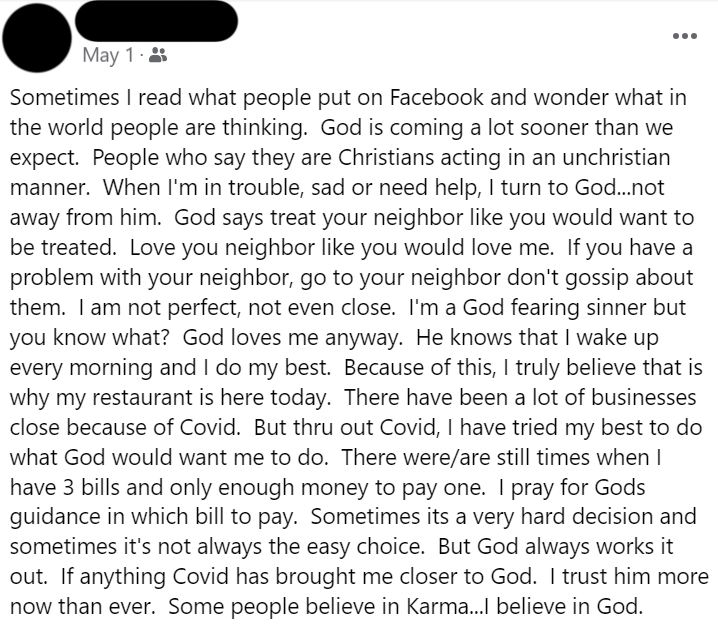
She made a total of three $250 payments that month. I felt that was unreasonably slow, given that it would have taken over a year to pay me off at that rate. But I would have accepted it. However, after three payments, they stopped. The status quo returned to them ignoring me and my invoices over the next three months.
(Broken) Promise to Pay after Public Exposure
In September, I shared on FB about their business practices, including screenshots of texts and emails as documentation. An owner of the business reached out and said he'd pay me in full that week, and asked that I'd consider taking down my posts. I did take them down, they didn't pay. (The initial portion of this exchange is below, including my somewhat salty response.)
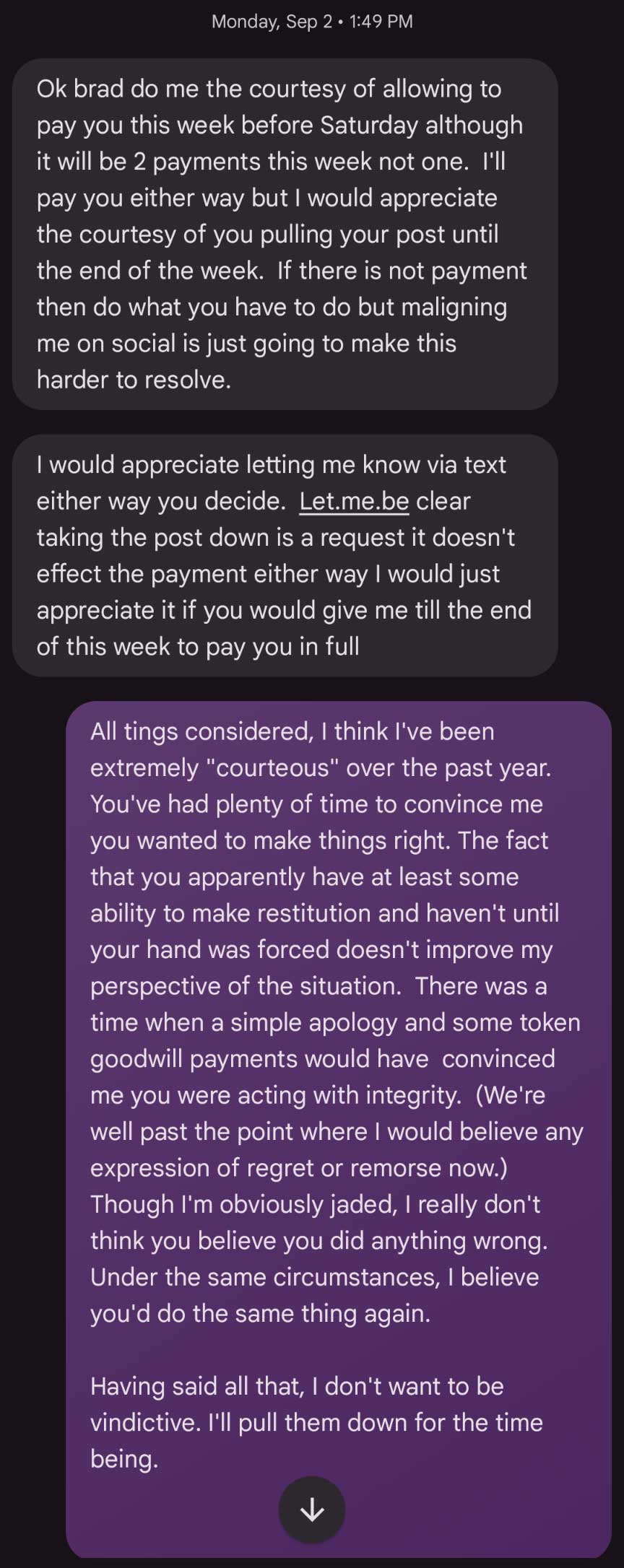
September 6th, they said they were getting a loan to pay me. Over the next several days, they told me it was in progress. 9/13 they said they'd send me proof that they were working on the loan. (They never sent anything.) 9/19 they said they'd send documentation by the end of the next day. (They didn't.) 10/1 they said they'd hopefully have the loan that week. 11/1 they admitted that the loan wasn't going to happen.
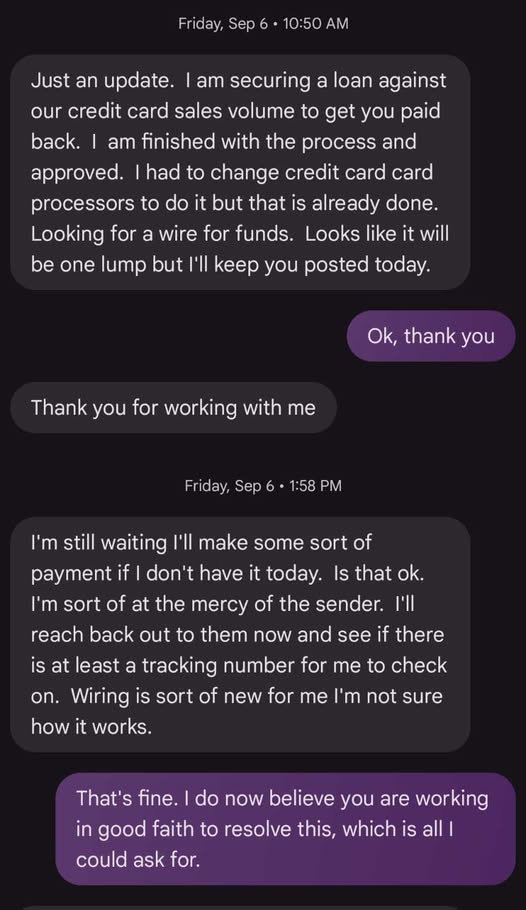
They never sent any automated payments, though they did make a few small manual payments during this time. I did the math, and at the rate they were paying me, it would have taken over 20 years for them to pay me--with no interest. And that's if they kept up the payments, which history suggests they wouldn't.
Legal Threats
Tired of being strung along, at the end of January, four months after their promise to pay in full in a week, I gave up and resumed publicly sharing on social media.
Recall that they said they would pay me whether or not I took the posts down, and would understand if I put them back up if they failed to pay me in a week. Instead of "understanding," they now decided to try to silence me with (bogus) legal threats.
Publicly and privately, the owners have claimed, or at least strongly implied, that they've been in contact with an attorney who told them I'm violating the law by sharing electronic communication, and am therefore in big trouble if I don't immediately do what they want. (I'm including a screenshot of their public post.) Here's the thing, that's simply untrue. Instead, this is just another example of them attempting to manipulate and bully others into doing what they want, with complete disregard for the truth.
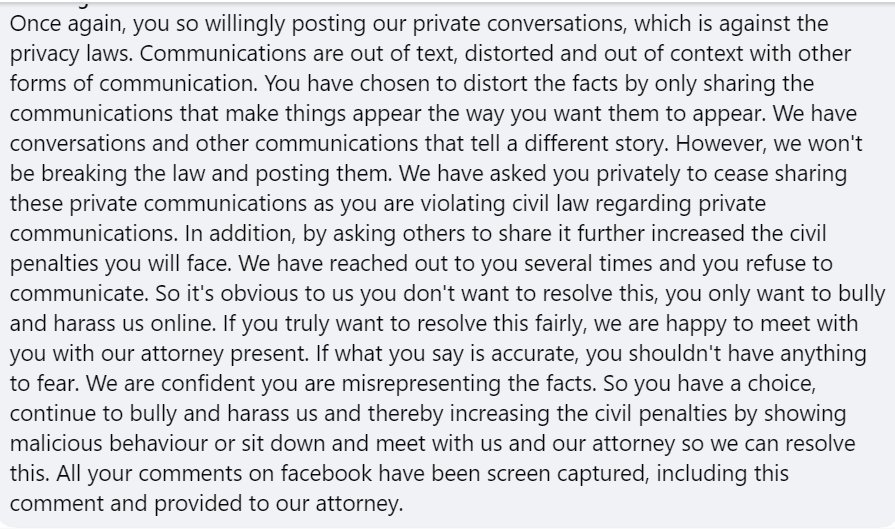
I doubt they contacted an attorney at all, but if they did they were told that Kentucky, like the majority of US states, is a one-party consent state. As long as one party from the conversation consents, the conversation can be publicly shared. I'm a party, and I consent. So the posts stayed up on Facebook, and the content is included here.
So, what did they accomplish by doing this?
First, they gave yet another example of the kind of tactics they use in their business. If you are considering doing business with them, be aware of what you are getting into.
Second, they ended any possibility of direct communication with me once and for all. If they want to attempt to bully, frighten, or manipulate me, they'll have to pay their lawyer $250 an hour (or whatever) to do it for them.
Third, they have only strengthened my resolve to warn others about their business practices. They have dug in their heels to such an extent, it appears to me they'd prefer to torch their reputations and destroy their business rather than honor the commitment they made to me. If nothing else, I can at least make it harder for them to take advantage of anyone else the way they did to me.
Attempted Fraud
In a new low, the owners decided to lie about our agreement in order deceive me into reducing or eliminating their debt. The act of deceiving someone to cheat them out of money, property or rights is the very definition of fraud.
The owners claimed that we had originally agreed that their expenses--and only their expenses--should be taken out before we calculate the ticket sales split. Unfortunately, we all immediately developed amnesia and never actually did that in the three years I was there. However, they were suddenly cured of their amnesia by their anger over me publicly sharing their behavior. So naturally they wanted to retroactively subtract all their expenses for the time I was there a full year and a half after I left.
As unbelievable as that claim is on its face, it would have been their word against mine. Except one of the owners sent multiple texts, one at the time I was leaving and one around a year later, both expressing regret that our agreement did not exclude expenses.
Here is the text message thread. It's a bit long, but I want to include it in its entirety.
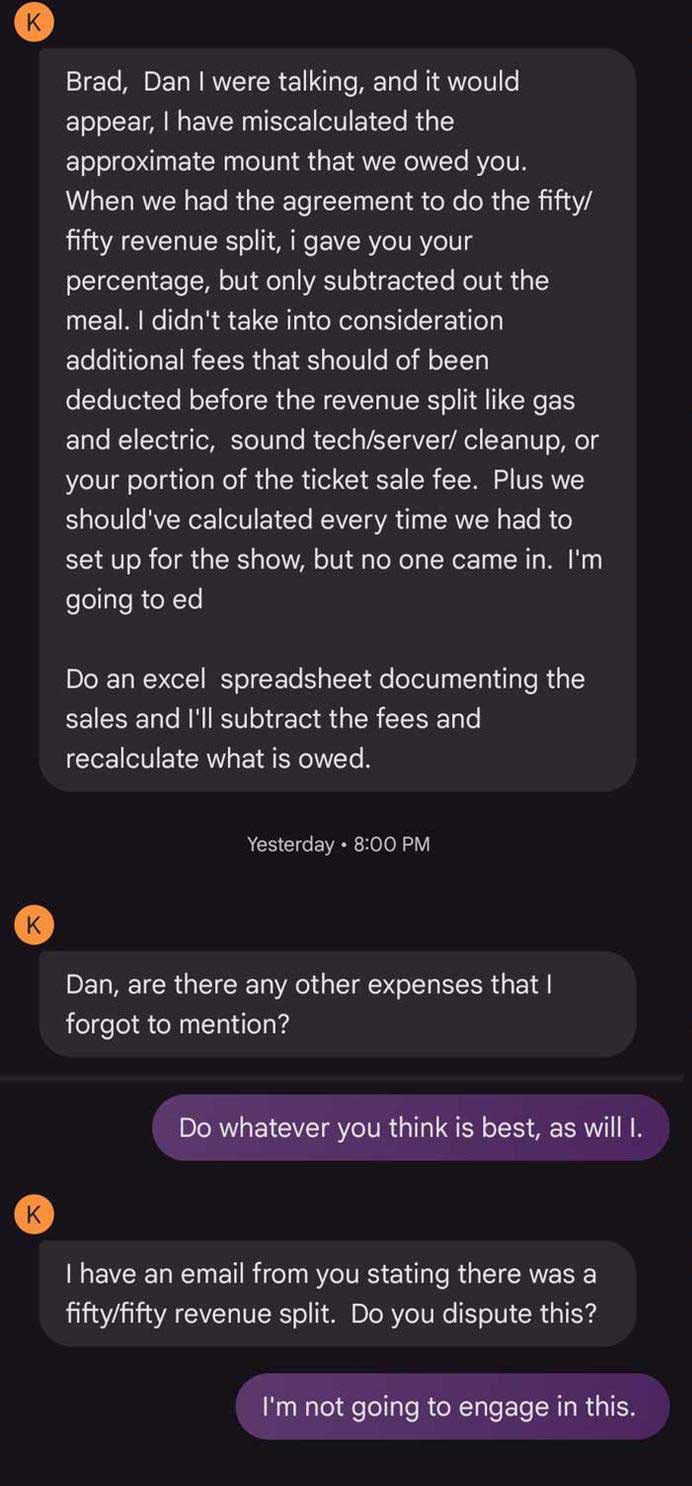
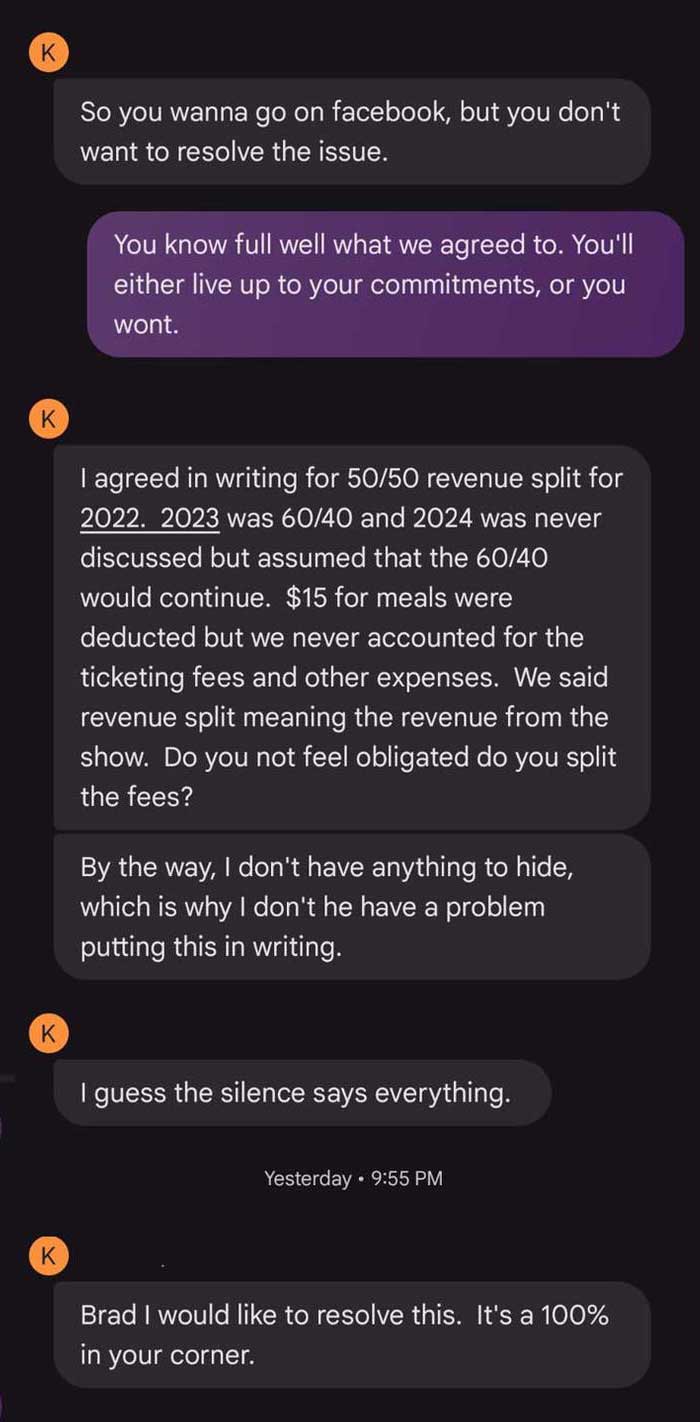
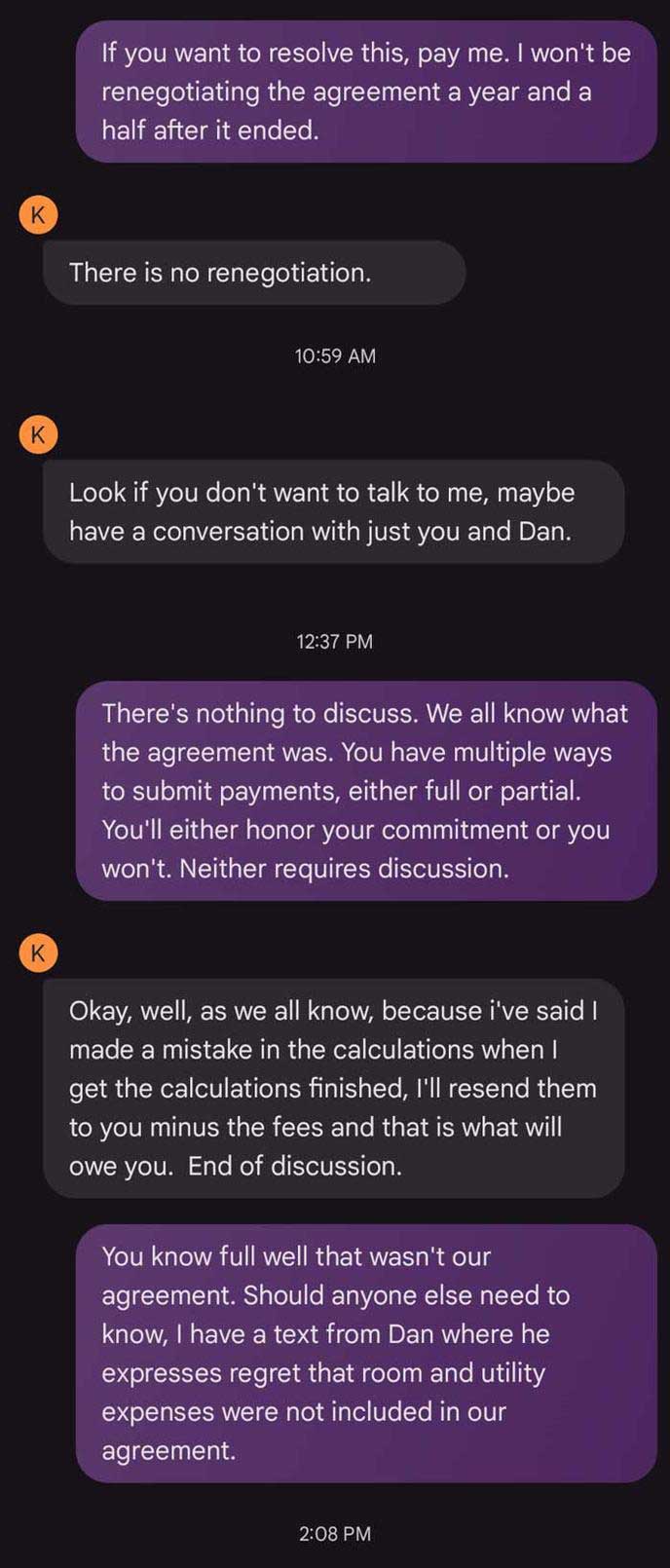
And here is the owner's response about his texts that refute his claim about our agreement. It's long, meandering, really doesn't say much. But, again, I want to include it in its entirety.
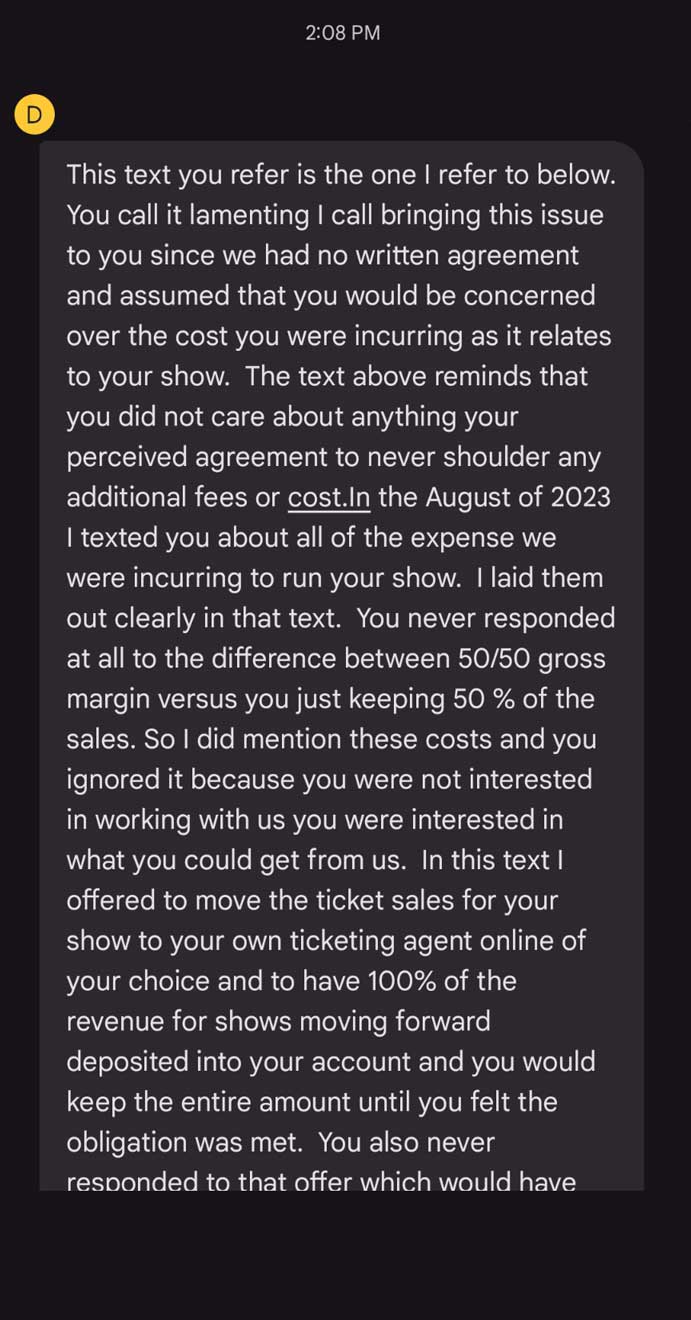
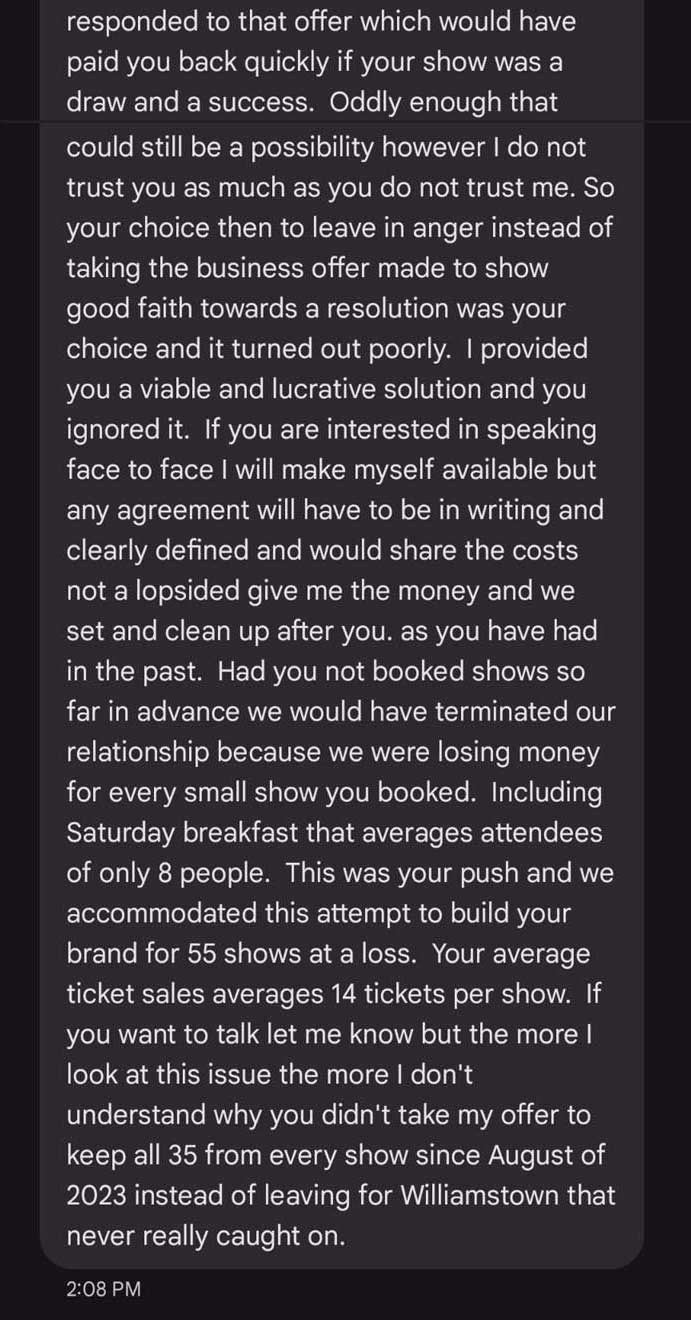
And finally, here is a text from one of the owners on December 4, 2024 explicitly stating that our agreement did not exclude rental, labor and utilities when calculating the revenue split. And yet, on January 28, 2025, less than two months later, they claimed the reverse was true, and wanted me to allow them to exclude those expenses.
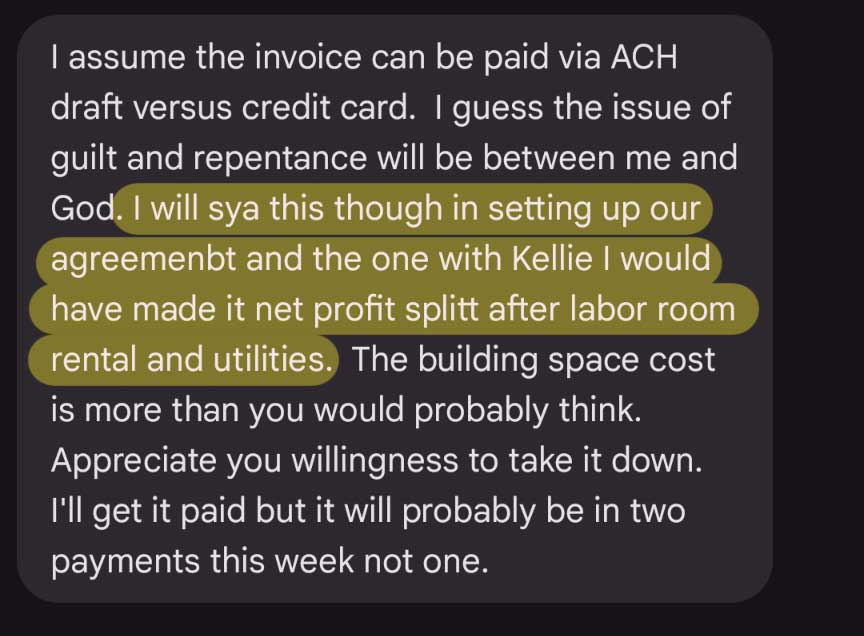
This is obviously underhanded behavior, but am I being reasonable to consider it an attempt to defraud me? Kentucky common law for fraud by misrepresentation has six elements that must be present. Let's take a look at each of them.
(1) A statement of material fact was made. That's an easy one. They claimed our agreement was that their expenses should be excluded from the ticket sales before the split was calculated.
(2) That statement was false. Again, that's pretty clear, as they refuted their own claims in writing.
(3) They knew the statement was false, or made it with reckless disregard for the truth. Once again, their own texts show they knew that what they were saying was false.
(4) The statement was made with the intent that the plaintiff (which would be me in this case) would act on it. Clearly, this element is also present, as they were explicitly asking me to take action--reduce their amount due--based on this information.
(5) The plaintiff acted in reliance on the misrepresentation, and that reliance was reasonable. This element was obviously not present, as I did not believe them and did not take action based on their false claims.
(6) The reliance on the false statement caused actual, direct, proximate damage. Had I believed them and allowed the amount due to be reduced, that would be actual damage. However, since I did not believe them, I was not damaged and this element was also not present.
So did they commit fraud by misrepresentation? No, but only because I didn't believe them and act on their false statement. So, I feel I have a good-faith basis for claiming that they absolutely did attempt to defraud me. Would the courts agree with my analysis? We'll never know, as there is no such thing as "attempted fraud by misrepresentation." Just as "attempted speeding" isn't a violation of the law, this isn't either. No matter how hard you try, it's only against the law if you actually successfully do it (and get caught).